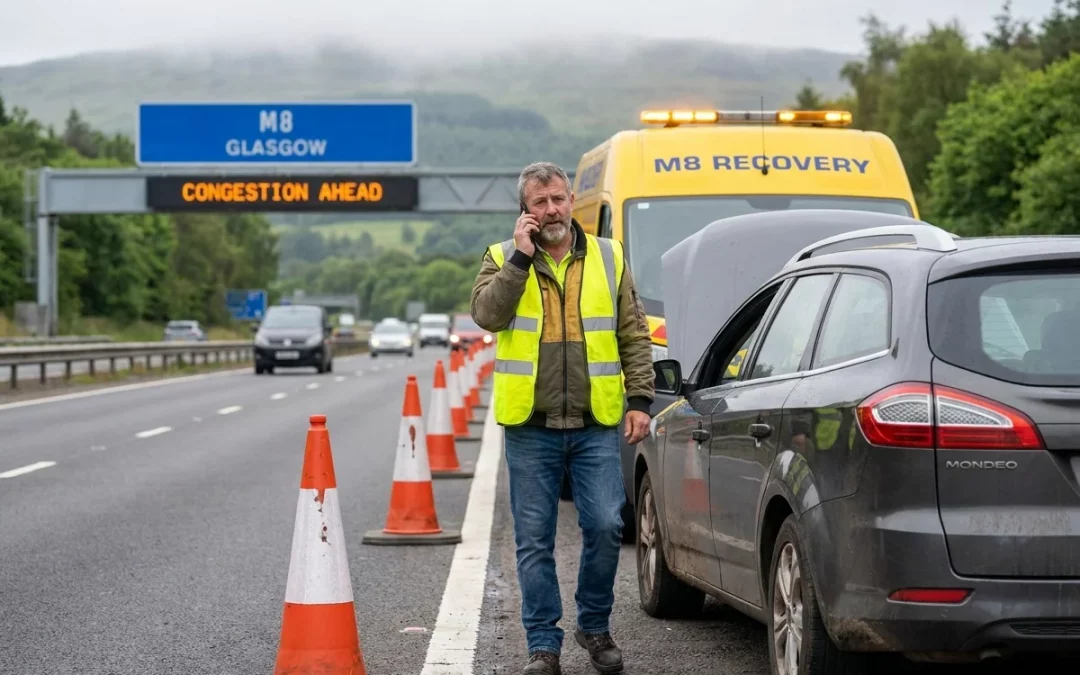
(For Illustrative Purposes Only)
Putting the wrong fuel in your car on the M8 happens more often than you’d expect, especially with over 100,000 vehicles streaming through Glasgow every day.
The junctions come at you quickly, the traffic never really lets up, and just one distracted moment at the pumps can leave you stranded on a slip road or hard shoulder with contaminated fuel in your tank.
If you’ve put petrol in a diesel car or diesel in a petrol car anywhere on the M8, don’t start your engine. Call 0131 235 2947 right away for mobile fuel drain recovery.
This guide covers every junction between J15 and J26, showing you where to pull over safely, whether you’re heading westbound into Glasgow or eastbound towards Edinburgh.
You’ll also see what happens in the first few minutes after you realise the mistake, what info our operators need, and how quickly we can reach you depending on your spot along the route.
If you’re driving elsewhere in the city, our full wrong-fuel Glasgow service covers all major roads and forecourts.
Whether you’ve already turned the key or caught your error just in time, knowing which junction to aim for and what to do next can save you time, money, and maybe your engine.
M8 emergency: the critical first 3 minutes
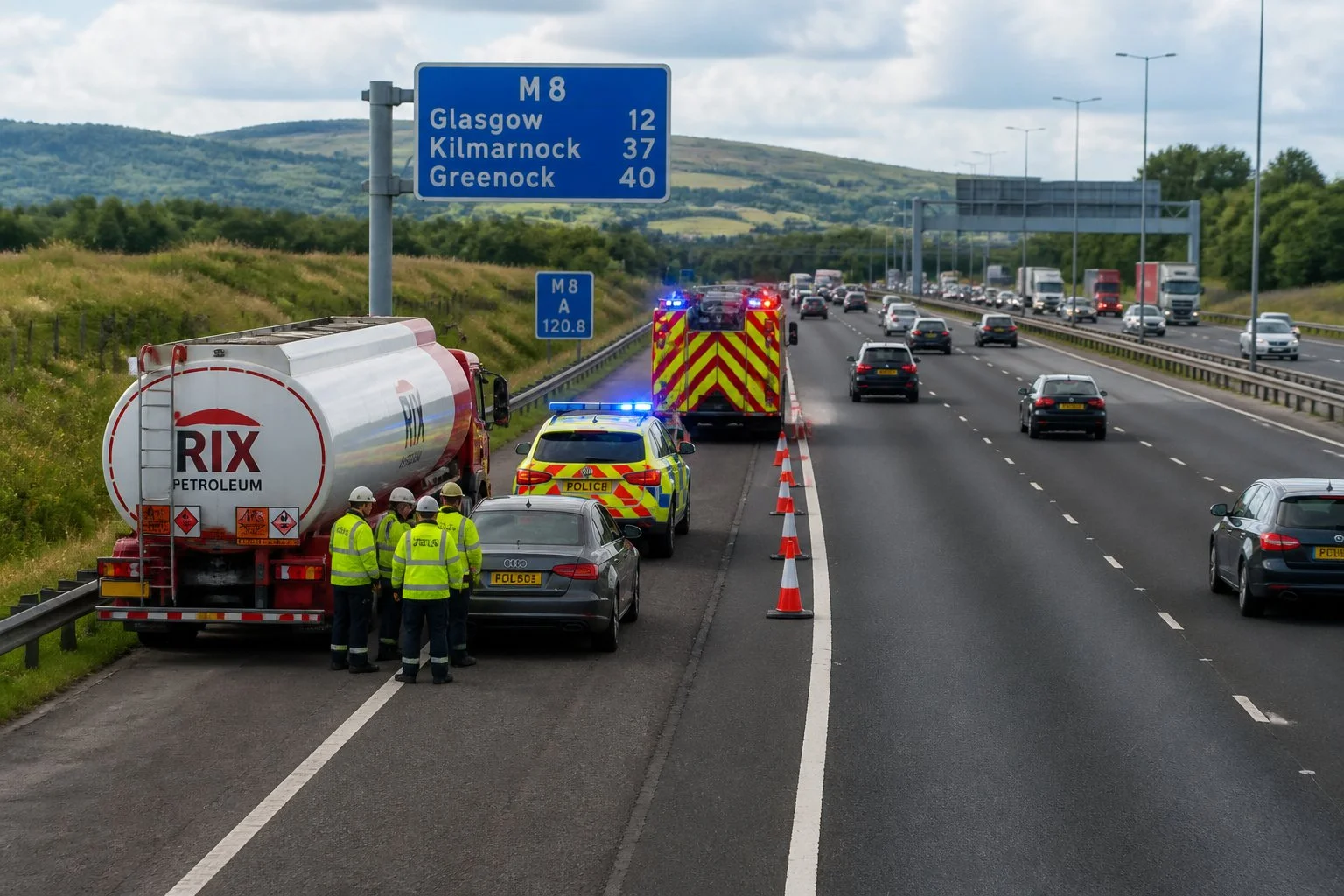
(For Illustrative Purposes Only)
The first three minutes after you realise you’ve misfuelled on the M8 can decide whether you just need a drain or end up with a massive repair bill.
Act quickly and try to stay calm.
Immediate actions in order:
- Don’t start the engine. If it’s running, switch it off right away and don’t try to restart.
- Switch on your hazard lights. Let other drivers know you’re in trouble.
- Move to the hard shoulder if it’s safe, or coast to the nearest exit without using the engine.
- Call us at 0141 374 2677 for emergency fuel drain help.
Modern diesel engines use high-pressure common rail systems. Once you start the engine after putting petrol in a diesel car, contaminated fuel surges through the pumps and injectors, and the damage can start almost immediately.
The M8 westbound through Glasgow is often a mess of roadworks and heavy traffic.
Don’t let the stress make you restart the engine. Even if you’re blocking a lane, stopping now is far better than breaking down completely or, in rare cases, overheating your engine.
If you’re in a safe spot away from live traffic, it’s usually best to stay in your car. But if you’re on a narrow section or near the Kingston Bridge, get out and stand behind the barrier if you can.
J15–J26 guide: safest pull-over point at each junction
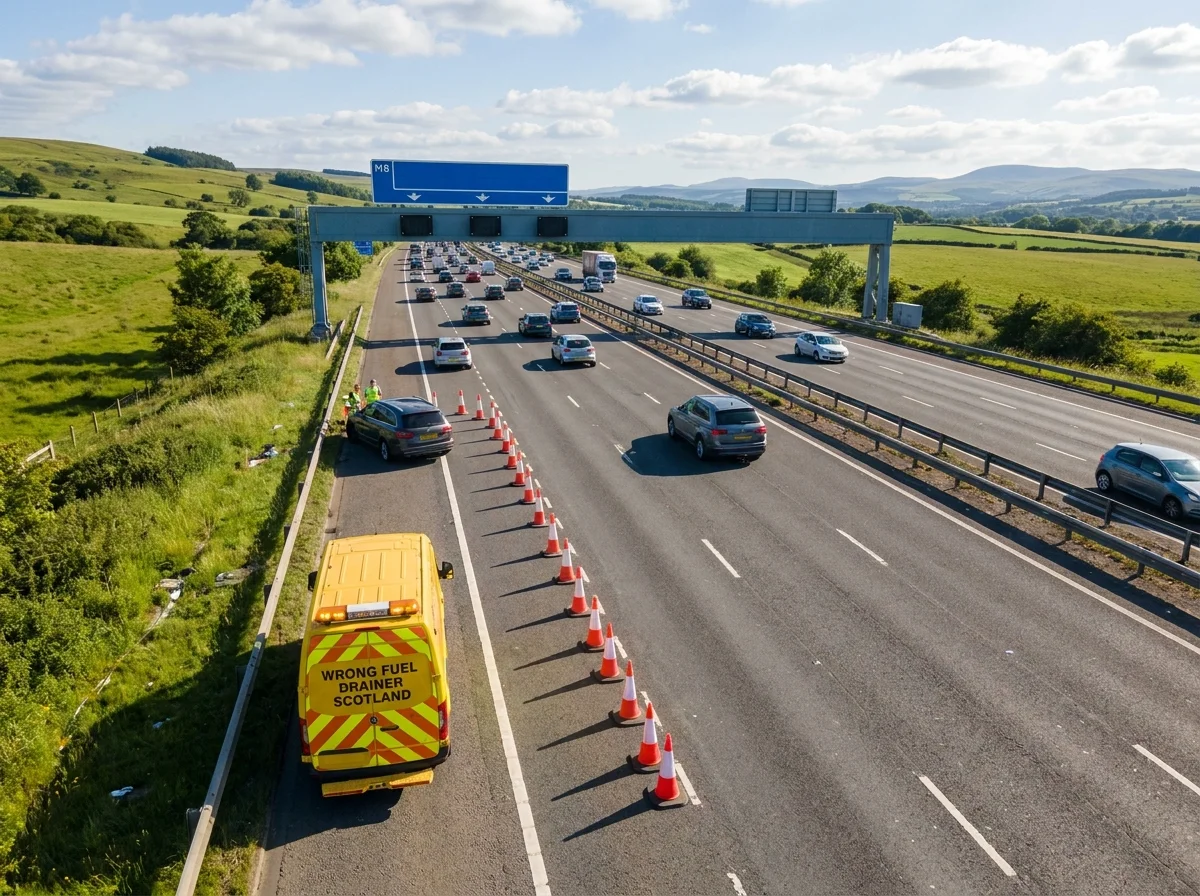
(For Illustrative Purposes Only)
If you’ve put the wrong fuel in your car on the M8, exit at the nearest junction as soon as possible. Don’t try to keep driving any further than you have to.
Junction 15 (Townhead) is your first safe exit heading eastbound into Glasgow. The A803 slip roads sit in the centre of the motorway, so signal early and pay close attention.
Junction 16 (Anderston) is critical. Exit here before you reach the M8 flyover; there’s no hard shoulder or safe spot to stop up there.
Junction 17 (Kingston) gives you options if your car still has a bit of momentum with the engine off. Use your hazards and whatever speed you have left to reach the slip road.
Junction 18 (Charing Cross) is the best bet for drivers heading west from the city centre. Take this exit and look for a car park or forecourt away from the main road.
Junction 20 (Tradeston) offers a quieter exit and better off-road parking nearby.
Junction 22 (Rutherglen Road) serves eastbound traffic as you approach the M73 interchange.
Junction 26 (Hillington) is the big east-end exit at the M73 interchange. The roundabout here is busy and has multiple lanes, so get into position early.
Our M8 response times: central (20–30 min) and east/west Glasgow (30–45 min)
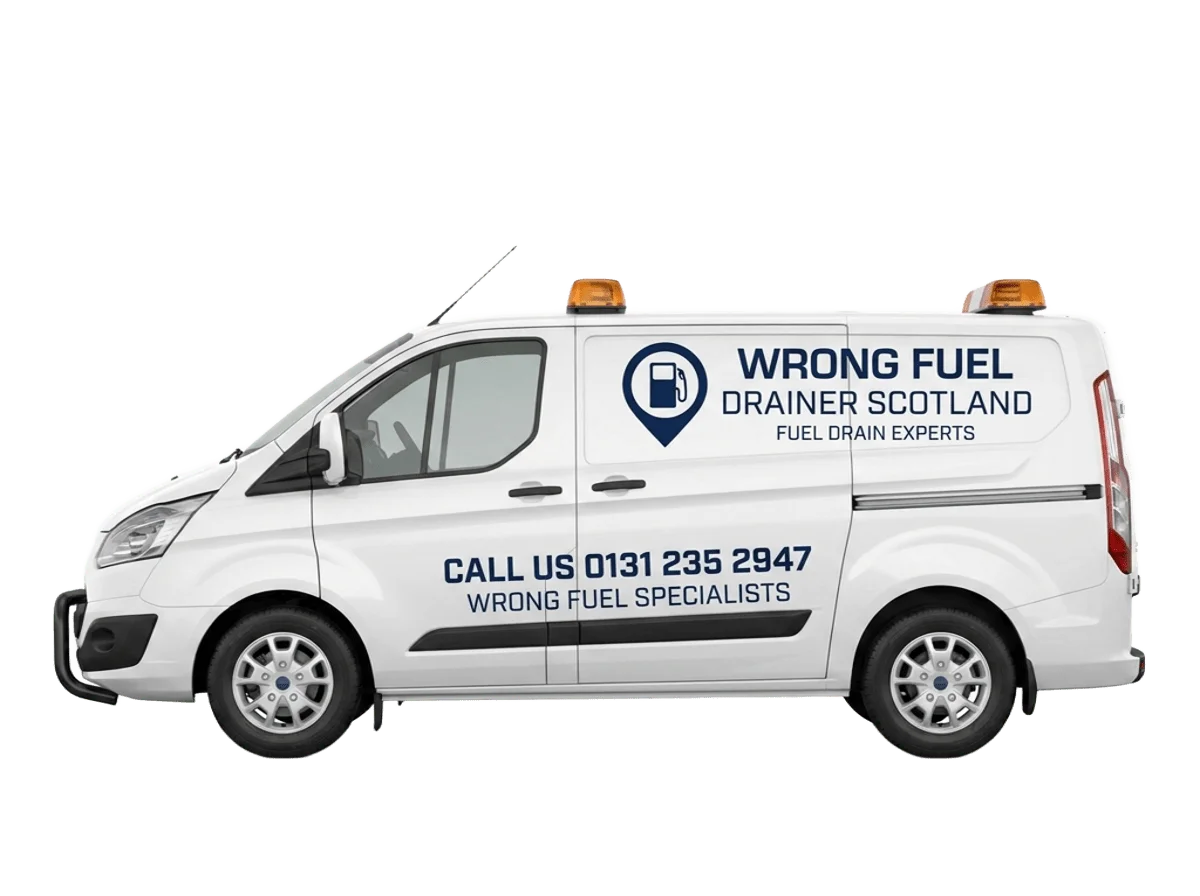
When you put the wrong fuel in your car on the M8, how fast someone can get to you really matters.
The wrong fuel drainer runs 24/7, all year, and doesn’t charge extra for nights or weekends.
Here’s what you can expect for response times, depending on where you are:
- Central Glasgow M8 (J15–J19, Kingston Bridge to Charing Cross): 20–30 minutes
- East Glasgow M8 (J20–J26, Baillieston direction): 30–45 minutes
- West Glasgow M8 (J18 westward towards Charing Cross): 30–45 minutes
We’re Scotland’s only independent PAS43 certified wrong fuel recovery service. Our technicians follow strict industry standards when they drain and flush your fuel system.
What to tell our operator: junction number, direction, engine started?
Before you call 0131 235 2947, try to have these five details ready so our technician can find you fast with the right gear.
Essential details to provide:
- Junction number: What’s the nearest junction, or which one did you just pass?
- Direction of travel: Are you heading west-bound (towards Glasgow and Greenock) or east-bound (towards Edinburgh)?
- Engine status: Did you start the engine after misfuelling? If so, how long did it run?
- Vehicle details: What’s your car’s make, model, and correct fuel type?
- Current location: Are you on the hard shoulder, in a layby, at a forecourt, or parked somewhere off the motorway?
Frequently Asked Questions
Misfuelling on the M8 brings its own headaches: heavy traffic, not much hard shoulder, and tricky spots like the flyover and Clyde Tunnel, where stopping isn’t just dangerous, it’s illegal. Here are answers to some of the most common questions drivers have about these situations.
What should I do if I misfuel on the M8 flyover section where there is no hard shoulder?
Don’t stop on the flyover. There’s no hard shoulder, and stopping would block a live lane.
If you catch the mistake before the flyover, exit at the nearest junction. If you’re already on the flyover when you realise, keep moving carefully until you can exit safely.
Turn on your hazard lights and maintain a steady speed. Once you’re off the motorway, find a safe place to park and call for help as soon as possible.
Can I stop in the Clyde Tunnel if I have put the wrong fuel in?
No. Stopping in the Clyde Tunnel is illegal and extremely dangerous.
The tunnel doesn’t have a hard shoulder, and traffic is constant in both directions. Emergency services can’t reach you safely, and your car could cause a serious crash.
If you misfuel before entering the tunnel, exit at Junction 19 or 20 instead. If you’re already inside, drive through carefully and get out at the first safe spot on the other side.
What are the warning signs and likely damage if diesel is put into a petrol car or petrol into a diesel car?
Petrol in a diesel car is the worst case. Diesel lubricates the fuel pump and injectors, but petrol doesn’t. If you start the engine, metal parts grind together and can wreck the fuel system fast.
Warning signs include rough idling, misfires, lots of smoke, and power loss. You might also see warning lights on the dashboard.
Diesel in a petrol car is less catastrophic, but still a problem. The engine might not start, or it could misfire and produce thick black smoke. The wrong fuel clogs up the spark plugs and fuel filter.
How can I reduce the risk of breakdowns or collisions when stopped near live traffic on a busy motorway?
Try to get your car as far left as possible if you’re on the hard shoulder. Turn on your hazard lights right away.
If it’s safe, exit through the passenger door and get behind the barrier. Never stand between your car and traffic.
If there’s no hard shoulder or barrier, stay in your car with your seatbelt on. Only get out if you see fire or smoke.
Call for recovery from a safe spot and give your exact location using junction numbers or marker posts.
Is it safe to wait on the M8 hard shoulder after a misfuel?
Waiting on the M8 hard shoulder? It’s honestly risky business. The motorway sees a constant rush of traffic, sometimes blasting by at 70 mph, just inches away from where you might stand.
If you have to pull over, get out through the passenger door. Stand behind the barrier; don’t hang around in your car unless you’re absolutely sure it’s safer inside.
Try to reach a junction, service area, or layby instead. If you can push your vehicle without firing up the engine, get it away from the live lanes and into a safer spot.